Residential properties in Middle Tennessee experience continuous insect pressure due to prolonged warm seasons and elevated subterranean soil moisture. The National our team documents an average…
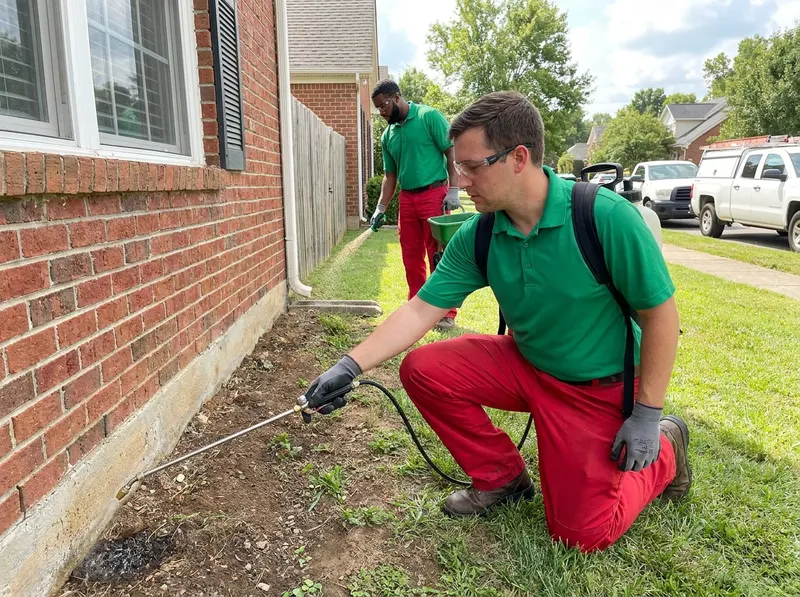
Residential properties in Middle Tennessee experience continuous insect pressure due to prolonged warm seasons and elevated subterranean soil moisture. The National Weather Service Nashville Office documents an average annual relative humidity exceeding 70 percent, creating optimal conditions for subterranean colonies of Tapinoma sessile (odorous house ants) and Camponotus (carpenter ants). Rather than coating indoor baseboards with synthetic insecticides, exterior barrier mitigation targets the building envelope. Technicians apply non-repellent liquid barrier bands along the base perimeter, extending 36 inches up masonry foundations and 36 inches outward into soil and mulch beds, adhering to protective environmental standards monitored by the Environmental Protection Agency. This exterior-only placement keeps living areas clean, preventing children, canine family members, and domestic pets from contacting wet compounds.
Older architectural designs across historic neighborhoods require tailored mechanical barriers. In 12 South and Belmont-Hillsboro, historic limestone foundations and brick piers feature open crawlspaces that channel moisture upward. The University of Tennessee Extension highlights that exterior moisture accumulation directly drives satellite colony establishment under siding and floor joists. Conversely, contemporary slab constructions in The Nations, East Nashville, and Germantown present insect entry pathways via brick weep holes and exterior plumbing conduits. Technicians install copper mesh and specialized exterior sealants along these utility entries, meeting the residential building standards outlined by the International Code Council to halt physical access without compromising structural airflow.
Seasonal climatic shifts across Davidson County alter pest migration patterns. Heavy spring rain events near the Cumberland River basin and Shelby Bottoms Greenway elevate the local water table, saturating topsoil and forcing subterranean ant nests toward dry framing. Guidelines from the National Pest Management Association confirm that perimeter barrier applications maintain residual efficacy between 60 to 90 days under moderate precipitation. For heavily wooded parcels bordering Radnor Lake State Park or properties situated throughout Green Hills, Sylvan Park, Inglewood, and Donelson, dense tree canopies produce damp leaf litter that bridges utility lines to roof eaves. Addressing these conditions involves clearing organic debris back 12 inches from external walls and treating foundation expansion joints, in alignment with principles published by the Entomological Society of America.
Selecting perimeter barrier defense over indoor broadcast spraying offers specific physical trade-offs. An exterior-focused regimen eliminates routine indoor chemical applications and removes the requirement for residents to vacate bedrooms or kitchens. However, this approach relies on insects crossing the active external perimeter, which means structural foraging activity drops steadily over 3 to 7 days rather than vanishing in an immediate knockdown. In areas with high limestone concentrations such as Antioch, clay soils require deep-root root-collar applications rather than surface-only mists, ensuring the active active ingredient binds securely to substrate particles in compliance with soil conservation rules established by the Natural Resources Conservation Service and consumer consumer guidelines from the Tennessee Department of Agriculture.
Every job gets a firm, written price after a free on-site visit.
Tell us about your perimeter ant and exterior barrier defense job in Nashville and we'll send a clear, written quote, usually the same day.
 CoastalElm Pest Treatment